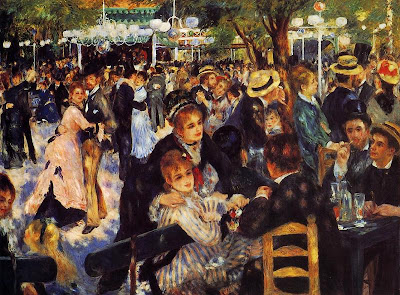
 Bal au moulin de la Galette, Montmartre was painted by French artist Pierre-Auguste Renoir in 1876. On May 17, 1990, it was sold for $ 78,000,000 at Sotheby's in New York City to Ryoei Saito, the honorary chairman of Daishowa Paper Manufacturing Company, Japan.
At the time of sale, it was one of the top two most expensive artworks ever sold, together with van Gogh's Portrait of Dr Gachet, which was also purchased by Saito. Saito caused international outrage when he suggested in 1991 that he intended to cremate both paintings with him when he died. Saito died in 1996 ... but the painting was saved.
 This painting by Paul Cézanne, painted in ca. 1893-1894 was sold for $60,500,000 at Sotheby's New York on May 10, 1999 to "The Whitneys". Whitney, born into one of America's wealthiest families, was a venture capitalist, publisher, Broadway show and Hollywood film producer, and philanthropist.
 Portrait de l'artiste sans barbe ("Self-portrait without beard") is one of many self-portraits by Dutch painter Vincent van Gogh. He painted this one in Saint-Rémy-de-Provence, France in September 1889. The painting is a oil painting on canvas and is 40 cm x 31 cm (16" x 13").
This is an uncommon painting since his other self-portraits show him with a beard. The self-portrait became one of the most expensive paintings of all time when it was sold for $71.5 million in 1998 in New York.
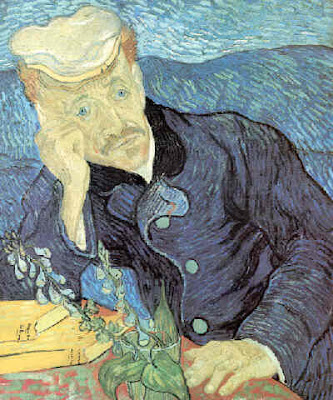 This painting by the Dutch Impressionist master Vincent van Gogh suddenly became world-famous when Japanese businessman Ryoei Saito paid $82.5 million for it at auction in Christie's, New York.
Vincent van Gogh actually painted two versions of Dr Gachet's portrait. You can view the other version, with a slightly different color scheme, at the Musée d'Orsay in Paris.
 This is one (and arguably the best) of the several scenes of a couple in bed painted by Toulouse-Lautrec, which have often been described as "dispassionate" despite the intimacy of the subject. While the composition looks really simple, the artist has used a very interesting perspective remarked by the striking colours.
 Born in an aristocratic family, and physically unable due to a genetic disorder that made his legs extremely short, Toulouse-Lautrec is known as the great chronist of the 19th century Paris nightlife. This painting, depicting a night in one of the most famous cabarets in Paris -the Moulin Rouge- is considered as one of his masterpieces, and, along with Renoir's "Moulin de la Galette" (see above), an unforgettable depiction of 19th century Paris nightlife.
 Impressionism had almost no presence in Spanish painting. In fact, the man who is often considered as the best impressionist painter in Spain -Joaquín Sorolla- was not a "pure" impressionist painter, though in his mature works his style was clearly influenced by that Art movement. This painting was sold for $6.2 million in 2003, an auction record for a work by Sorolla.
 Sisley painted several canvases depicting these floods in Port-Marly, but the two more outstanding examples are those that show the river's waters around a wine shop at Rue Paris. We can suggest a link between these paintings and the turbulent biography of their creator: it is possible that Sisley saw the floods in the quiet town of Port-Marly as a reflection of his own life: troubled and overflowed after several events as unforeseeable and inevitable as the floods of the Seine River.
 If we want to look for the "pure", essential impressionist painters, such list would be reduced to only three names: Claude Monet -the real Michelangelo of the impressionist era-, Camille Pissarro -the great chronicler of the rural life- and Alfred Sisley. Sisley's paintings of the small town of Louveciennes are arguably his greatest achievements, and this simple but powerful canvas is perhaps the best of all them.
 Theodore Robinson (1852-1896) is without question one of the key figures in the American Impressionism. A close friend of Claude Monet, he created some of his best works while living in Giverny, just few months before returning to America. "La dèbâcle" is a typical work by Robinson, executed au plein air, and depicting a young woman in a leisure activity
 "About 1883, a rupture occurred in my work. I had come to the end of Impressionism, and I arrived at the conclusion that I could neither paint nor to draw. In one word, I was at a dead end". "The Umbrellas" is a complex work in which we can find Renoir in two different periods of his career. While the precise drawing of the girl on the left can be easily ascribed to his 'Impressionist' period, some figures on the right should be identificated with his "dry" or "Ingres" period, started in 1883.
 This masterwork has been described as “the most beautiful painting of the 19th century”. The painting depicts one of the numerous dances that took place in the Moulin de la Galette, one of the most frequented clubs in 19th century Montmartre, a paradise for bohemians and artists like Toulouse-Lautrec, van Gogh or Renoir himself. One of the supreme masterworks from early Impressionism.
 Some experts have called this work "the origin of Impressionism". Manet shocked the Art world when he exhibited the painting at the Salon des Refusés in 1863. Émile Zola wrote about this monumental canvas: "It is, in short, this vast ensemble, full of atmosphere, this corner of nature rendered with a simplicity so just, all of this admirable page in which an artist has placed all the particular and rare elements which are in him".
 What a slut!", George Moore commented about the woman in this painting, adding that "the tale is not a pleasant one, but it is a lesson", and also that "no one has said so much in so little space, and no one has expressed in such a simple way (...) thanks to the science of the drawing, invisible but omnipresent, almost impersonal". The sad and melancholic "Absinthe drinkers" appears to have influenced works of later artists, such as Picasso's interiors from the Blue Period, or Edward Hopper's urban scenes.
 Degas paintings of young dancers or ballerinas are among his greatest -and of course most famous- achievements. Degas depicted these young girls as true professionals, practicing all day long under the strict tutelage of the master. In this canvas, the dance master appears at the center-right of the composition, supervising the scene like an authority at the height of his powers.
 This is the largest canvas Cézanne ever painted, and the fabulous culmination of the "Bathers" series. The painting is reminiscent of some Titian's finest paintings, such as the "Bacchanal of the Andrians", while the almost sculptorical representation of the human body link this canvas with some of Michelangelo's frescoes at the Vatican. Two other "finished" "Bathers" paintings exist, one in the Museum of Modern Art in New York City and the other in the National Gallery, London.
 Granddaughter of Fragonard, the famous 18th century French painter, and raised in a wealthy family, Morisot was an active member of the Impressionist movement, and even Manet admired her artistic style. In his last works, the influence of Renoir is evident.
 Art, Claude Monet impressionist painting. Claude Monet was a founder of French impressionist painting, and the most consistent and prolific practitioner of the movement's philosophy of expressing one's perceptions before nature, especially as applied to plein-air landscape painting. The term Impressionism is derived from the title of his painting Impression, Sunrise.


