CSS TAB DESIGNER

Tab Menu 10


Showing posts with label Naturalism. Show all posts

Wednesday, April 25, 2012

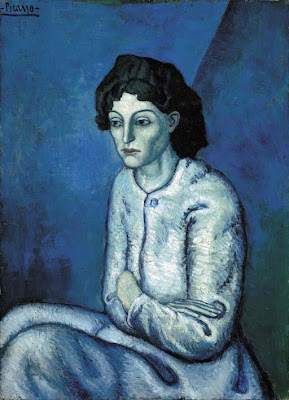
$55,000,000 for Femme aux Bras Croises by Pablo Picasso (2000)


     This work, painted in 1901, was a part of Picasso's famous Blue Period, a dark, sad time in the artist's life. The beautiful & various tones of blue are typical. The painting depicts a woman with her arms crossed staring at the endless nothing.


      Femme aux Bras Croisés was sold for $55,000,000 November 8, 2000, at Christie's Rockefeller in New York City.

Friday, April 13, 2012

Tuesday, March 13, 2012

Roger Tory Peterson (1908-1996) - Tropical Birds


     NY.- Christie’s announced the upcoming sale of twenty original paintings by the celebrated naturalist, artist, and educator Roger Tory Peterson (1908-1996). Peterson’s best-selling field guides, beginning with his seminal 1934 book A Field Guide to the Birds of North America, have been a must-read for generations of ornithologists and bird-watchers alike. This selection of original paintings and works on paper, consigned directly from Peterson’s art studio, represents the largest selection of works by the late artist ever to be offered to the public. 

Christian Krohg (1852 – 1925)

Think that you may own a painting by Christian Krohg? We authenticate, appraise, research and issue certificates of authenticity (COA) and provide consultations for all paintings by Christian Krohg.


Krohg

Christian Krohg was a Norwegian naturalist painter, author and journalist. Krohg was educated in Germany and worked in Paris from 1881 to 1882. Inspired by the thoughts of the realists he chose motives primarily from everyday life – often its darker or socially inferior sides. Particularly well known are his pictures of prostitutes, and his novel Albertine from 1886 is about this theme. The book caused a scandal when first published, and was confiscated by the police. Krogh’s powerful and straightforward style made him one of the leading figures in the transition from romanticism to naturalism, characteristic of Norwegian art in this period. Through his periodic residence at Skagen, where he arrived for the first time in 1879, he had great influence on Anna and Michael Ancher.


Struggle for Existence


Krohg was a journalist in the Oslo newspaper Verdens Gang 1890-1910, where he wrote remarkable portrait interviews. Later he became a professor director at Statens Kunstakademi (The Norwegian academy of arts) 1909-1925. He was married to painter and bohéme princess Oda Krohg, and the father of painter Per Krohg (1889-1965).


Self-Portrait with Canvas


Still wondering about a Norwegian painting in your family collection? Contact us…it could be by Christian Krohg.

John Pototschnik

Paintings Reproductions Dupre, Julien Returning from the Fields, 1895

Cheetahs

Tuesday, January 10, 2012

View Of Delt by Johannes Vermeer, 1659-60


    This, the most famous painting by Vermeer, was part of the Amsterdam sale of 1696, no. 31: "The town of Delft in perspective, to be seen from the south, by J. van der Meer of Delft; fl 200." Sale S. J. Sinistra et al., Amsterdam; 1822, no. 112. For F 2,900 to de Vries. Purchased by the state of the Netherlands. 

    Topographic views of cities had become a tradition by the time Vermeer painted his famous canvas. Hendrik Vroom was the author of two such works depicting Delft, but they are more archaic because they followed the traditional panoramic approach that we remember from the two cityscapes by Hercules Seghers at the Berlin museum. The latter artist was one of the first to make use of the inverted Galilean telescope to transcribe the preliminary prints and their proportions (more than twice as high as wide) into the more conventional format of his paintings. 

     Vermeer executed his View of Delft on the spot, but the optical instrument pointed toward the city and providing the artist with the aspect translated onto canvas, which we admire for its conciseness and special structure, was not the camera obscura but the inverted telescope. It is only the latter that condenses the panoramic view of a given sector, diminishes the figures of the foreground to a smaller than normal magnification, emphasizes the foreground as we see it in the picture, and by the same token makes the remainder of the composition recede into space. The image thus obtained provides us with optical effects that, without being unique in Dutch seventeenth-century painting, as often claimed, convey a cityscape that is united in the composition and enveloped atmospherically into glowing light. 

      We admire the town, but it is not a profile view of a township, but a painting, an idealized representation of Delft, with its main characteristics simplified and then cast into the framework of a harbour mirroring selected reflections in the water, and a rich, full sky with magnificent cloud formations looming over it. This is chronologically the last painting by Vermeer that was executed in rich, full pigmentation, with colour accents put in with a fully loaded brush. The artist outdid himself in a rendition of his hometown, which stands as a truly great interpretation of nature.

Buddha Paintings

Oil art paintings

     Oil Paintings Art Reproductions. Famous Masters. Buddha paintings . Oil paintings art reproductions from the famous masters and old painters. Buddha paintings, Thai art and Thai paintings. Portrait paintings 

Saturday, December 31, 2011

Two Sisters (On the Terrace), Pierre-Auguste Renoir

Two-Sisters-Painting

   Two Sisters (On the Terrace), Pierre-Auguste Renoir – This masterpiece by Renoir is a celebration of the beauty of spring and the promise of youth. Interestingly, the two girls depicted in the painting were not sisters, as indicated by the work’s original title, but unrelatedmodels.

Thursday, November 10, 2011

Basuki Abdullah Painting. Part 2

the wayang figures Gatotkaca and Antasena


Kanjeng Ratu Kidul


Berjemur Di Atas Matahari

Sunday, October 23, 2011

Campagne de France-All Jean-Louis-Ernest Meissonier's Paintings

All Jean-Louis-Ernest Meissonier's Paintings

Campagne de France, Jean-Louis-Ernest Meissonier


Campagne de France
1814. Campagne de France (Napoleon and his staff returning from Soissons after the Battle of Laon), 1864

Garden-Jean-Franc Millet Oil Paintings

Jean-Franc Millet Oil Paintings


Garden, Jean-Franc Millet

Garden

Saturday, October 15, 2011

Jean François Millet French Painter 1814-1875

Jean François Millet
French Painter 1814-1875


"One must be able to use the trivial to express the sublime-that is true power!"-Jean Francois Millet


Jean Francois Millet was a French painter, etcher and draughtsman associated with the Barbizon school, his later works were criticized for expressing socialist ideas. Millet was noted for his depictions of peasant life. Jean Francois Millet can be categorized as part of the naturalism and realism movements.

Jean Francois Millet was born on a farm near Cherbourg and never forgot that he had spent his boyhood working in his father's fields. He showed an early talent for drawing and was sent to study with a painter in Cherbourg when he he was 20 years of age. In 1837 he received a scholarship to study in Paris, where he became a pupil in the studio of Paul Delaroche. The inflexible training Jean Francois Millet received was too much for his temperament and he gave up formal study to work alone in the Louvre, where he admired the works of Mantegna, da Vinci, Giorgione, and Poussin.

For some years, Millet supported himself by painting portraits, pastoral subjects, and decorative panels. Fighting against great odds, and suffering a long period of extreme hardship, Millet exhibited at the Salon for the first time in 1840, and married two years later. During this period his main influences were Poussin and Eustache Le Sueur, and the type of work he produced consisted predominantly of mythological subjects or portraiture, at which he was especially adept. Jean Francois Millet became a member of the French Academy in 1847. In the following year, however, Jean Francois Millet discovered that his real vocation as an artist lay in painting the land that he could never abandon.

Wednesday, October 12, 2011

Works of Basuki Abdullah

Works of Basuki Abdullah


Childern Basuki Abdullah Painting


Basuki Abdullah Biography

 Basoeki Abdullah (born in Surakarta, Central Java, January 25, 1915 - died 5 November 1993 at age 78 years) is a master painter Indonesia. He is known as a painter and naturalist aliranrealis. He has been appointed the official painter Merdeka Palace in Jakarta and his works adorn the palaces of the state and the presidency of Indonesia, in addition to a collection of goods from all over the world.

Talent inherited from his father painted Suryosubro Abdullah who is also a painter and dancer. While his grandfather was a prominent Indonesian National Awakening Movement in the early 1900's ie Doctor Wahidin Sudirohusodo. Since the age of 4 years Basoeki Abdullah began to love to paint some well-known figures such as Mahatma Gandhi, Rabindranath Tagore, Jesus Christ and Krishnamurti.Basoeki Abdullah formal education obtained in his Catholic and Catholic junior in Solo.Thanks to the help of Pastor Koch SJ, Basoeki Abdullah in 1933 obtained a scholarship to study at the Academic Arts (Academie Voor Beeldende Kunsten) in The Hague, Netherlands, and completed his studies in 3 years with the award-winning Royal International Certificate of Art (RIA).During the Japanese Government, Basoeki Abdullah joined the Movement of People's Power Center or Poetra which was formed on March 19, 1943. Within this movement Poetra Basoeki Abdullah was given the job of teaching the art of painting. His students include Kusnadi (painter and art critic of Indonesia) and Zaini (impressionism painter). In addition Poetra organization, Basoeki Abdullah also active in Keimin Sidhosjo Bunka (the Japanese government's Cultural Center) together Affandi, S. Sudjoyono, Otto Djaya and Basoeki Resobawo.In times of revolution Bosoeki Abdullah was not in the ground water that until now not clear what lies behind it. Clearly on 6 September 1948 held in Amsterdam the Netherlands during the coronation of Queen Juliana in which the painting competition was held, Basoeki Abdullah managed to beat 87 European painters and managed to come out as winners.Painting "Balinese Beauty" by Basoeki Abdullah sold at Christie's auction in Singapore in 1996.Since it is also the world began to recognize Basoeki Abdullah, son of Indonesia that it the name of Indonesia. Over in the Netherlands Basoeki Abdullah often traveled around Europe and also the opportunity to deepen the art of painting by exploring Italy and France where many artists live with a worldwide reputation.Basoeki Abdullah known as a portrait painter, mainly painting beautiful women, royal families and heads of state are likely to enhance or beautify a person rather than the original face. Apart from being an accomplished portrait painter, he too paints landscapes, fauna, flora, the themes of struggle, construction and so forth.Basoeki Abdullah held many solo exhibitions both domestically and abroad, among others, his work ever exhibited in Bangkok (Thailand), Malaysia, Japan, Netherlands, England, Portugal and other nations. Approximately 22 countries that have paintings Basoeki Abdullah. Almost all of his life was spent abroad including several years living in Thailand and was appointed as the Presidential Palace and the painter since 1974 Basoeki Abdullah lived in Jakarta.Basoeki Abdullah besides a painter is also good at dancing and puppet dances are often performed by people as Ravana or Hanuman. He not only mastered about puppetry, Javanese culture where it originated, but also fond of the composition-kompasisi Franz Schubert, Beethoven and Paganini, with such broad horizons as an artist and not Jawasentris.Basoeki Abdullah married four times. Yoshepin his first wife (the Netherlands) but then split up, had a son named Saraswati. Then married again to Maya Michel (split) and So Mwang Noi (bepisah anyway). Nataya Narerat married last until the end of his life and had children Cicilia SidhawatiBasoeki Abdullah was killed robbers at his home on November 5, 1993. His body was buried in the village of Mlati, Sleman, Yogyakarta.


Related Posts Plugin for WordPress, Blogger...

FAMOUS

Add to Google Reader or Homepage Subscribe in NewsGator Online Add to My AOL Add to netvibes Subscribe in Bloglines Add to The Free Dictionary Add to netomat Hub Add to Webwag